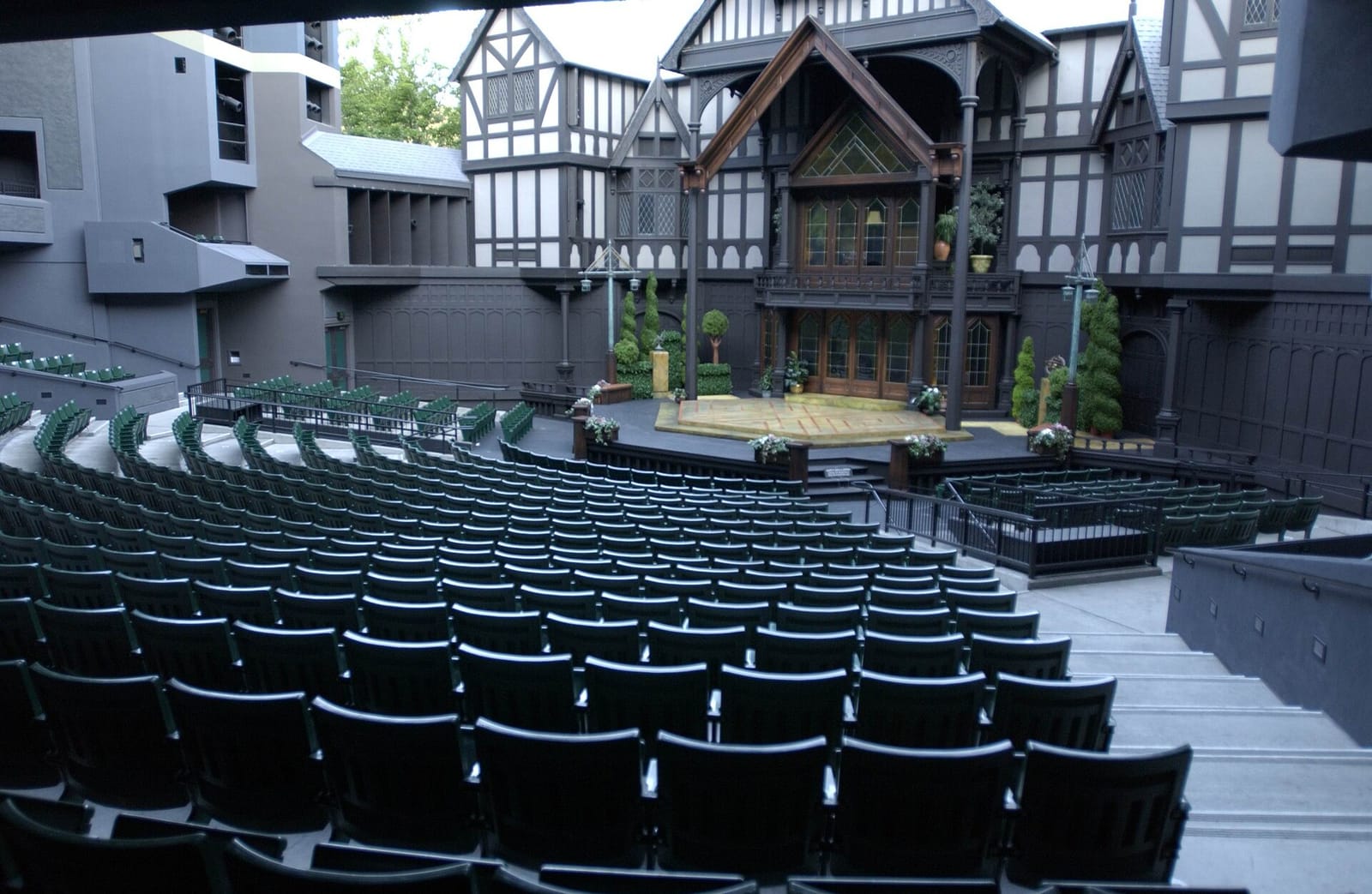
Theatre is not therapy
As a Shakespearean director often reminded his young students, “Theatre is not therapy.” The stage, he meant, was a place to make art—and magic—not to work out personal issues or resolve childhood traumas. An audience used in this way, would have a right to be resentful, and might well be bored to tears.
Having been a student of this director, I couldn’t help wondering whether Jon Moscone, as director and co-developer of “Ghost Light” might fall into that trap. It would have been understandable, considering the subject matter: the psychological impact of the assassination of San Francisco Mayor George Moscone on his 14-year-old son and the man he would become.
The answer, thankfully, is a resounding ‘No.’ While the creative process may have been healing for Moscone, this world premiere production is a triumph and a compelling piece of theatre that clearly serves art for art’s sake. Moscone, along with co-developer Tony Taccone, bestow the audience with the gifts of a literate and carefully-chiseled script. And, perhaps most important, when speaking with sardonic wit through his most-likeable namesake character, Moscone doesn’t takes himself seriously. There’s never a lapse into a pity party. If there is to be a catharsis on this stage, he and Taccone assure that it is a communal one based on shared truths. If anything, this is a celebration of a life—and a relationship—reclaimed.
If anything, this is a celebration of a life—and a relationship—reclaimed.
Hamlet as the key
In this reimagined story that tracks historical fact, Jon is a theatre director and acting teacher. While struggling with how to stage the appearance of the ghost of Hamlet’s father, he grapples with emergent ghosts and dream agents from his own haunted past.
“Hamlet,” the play, isn’t merely the thing here, it’s a well-chosen theatrical key to unlock a Pandora’s Box of suppressed memories, ones that were snatched from the “backstreets” of Jon’s “twisted imagination.” Well-armed with a deeply drawn character and a clever script, Christopher Liam Moore, plays Jon with unselfconscious abandon and a light deft touch as he escorts us into his equally-fascinating parallel inner and outer worlds. In Moore, it is easy to see that Jon is the son of an unusually charismatic and effective politician.
The fact that Jon’s character is so affable can be credited, in no small part, to the splendid, seemingly effortless performance of Robynn Rodriguez who plays Jon’s confidante and creative partner Louise. More than anything, their friendship helps us to care.
In a scene that sets the tone, and reveals the trauma, we engage initially with Jon the teenager (Tyler James Myers), a character as seen through the lens of his adult counterpart. We witness his emotional flattening by the bombastic broadcast news of his famous father’s 1978 City Hall murder—along with that of gay activist and Supervisor Harvey Milk. Myers’ performance, one that is critical to appreciating Jon as an adult, is properly restrained and nuanced. In one of a series of poignant scenes, the boy clings desperately to his father’s casket, wrestling against the will and wishes of a manifested spirit guide referred to in the script merely as Mister. As played by Derrick Lee Weeden, he carries this considerable role with convincing emotional heft and conviction.
Dream time and real time
In a play where stage time is driven, in part, by dream time and dream logic, and truth is an intricate weave of filtered memories, director Moscone maintains a remarkable degree of story clarity by allowing Jon, the character, to contend with real-time complications and conflicts. For instance, how, or even will, he solve the theatrical riddle of the staging of Hamlet’s father’s ghost? Will he ultimately find love—or even momentary solace—in the arms of his cyber-boyfriend, Loverboy?”
As a vehicle to access truth trapped within a tsunami of turbulence, Moscone and Taccone give us the most memorable character in the persona of Prison Guard. Playing this maniacal manifestation of Jon’s grandfather in full uniform, Bill Geisslinger serves to haul Jon out by the scruff of his subconscious into awareness and acceptance of the pain of his past. Ultimately, he helps make it possible to Jon to acknowledge, “I am the son of my father.”
You will find this production well-served by the design work of Todd Rosenthal, who provides a substantial set on two expansive levels that permit Moscone at times to play out both his real and imagined scenes in parallel.
For good reason, “Ghost Light” will be heard from again and again. You can see it at OSF’s New Theatre through Nov. 6.
I rate “Ghost Light” four and a half Roseys!
Questions people ask
- Where and when did Ghost Light premiere?
- At Oregon Shakespeare Festival's New Theatre in Ashland, Oregon, in the 2011 season, running through November 6, 2011.
- Who created it?
- Director Jon Moscone, son of the late San Francisco mayor George Moscone, developed the play with Tony Taccone, who wrote the script.
- Who played Jon?
- Christopher Liam Moore, with Robynn Rodriguez as Louise, Tyler James Myers as the teenage Jon, Derrick Lee Weeden as Mister and Bill Geisslinger as Prison Guard.
Sources
This page was rebuilt from the Commission’s archived website. It is kept for reference; see the home page for what the Commission was.