In the zone at the Elizabethan
Run, Charlie, Run.
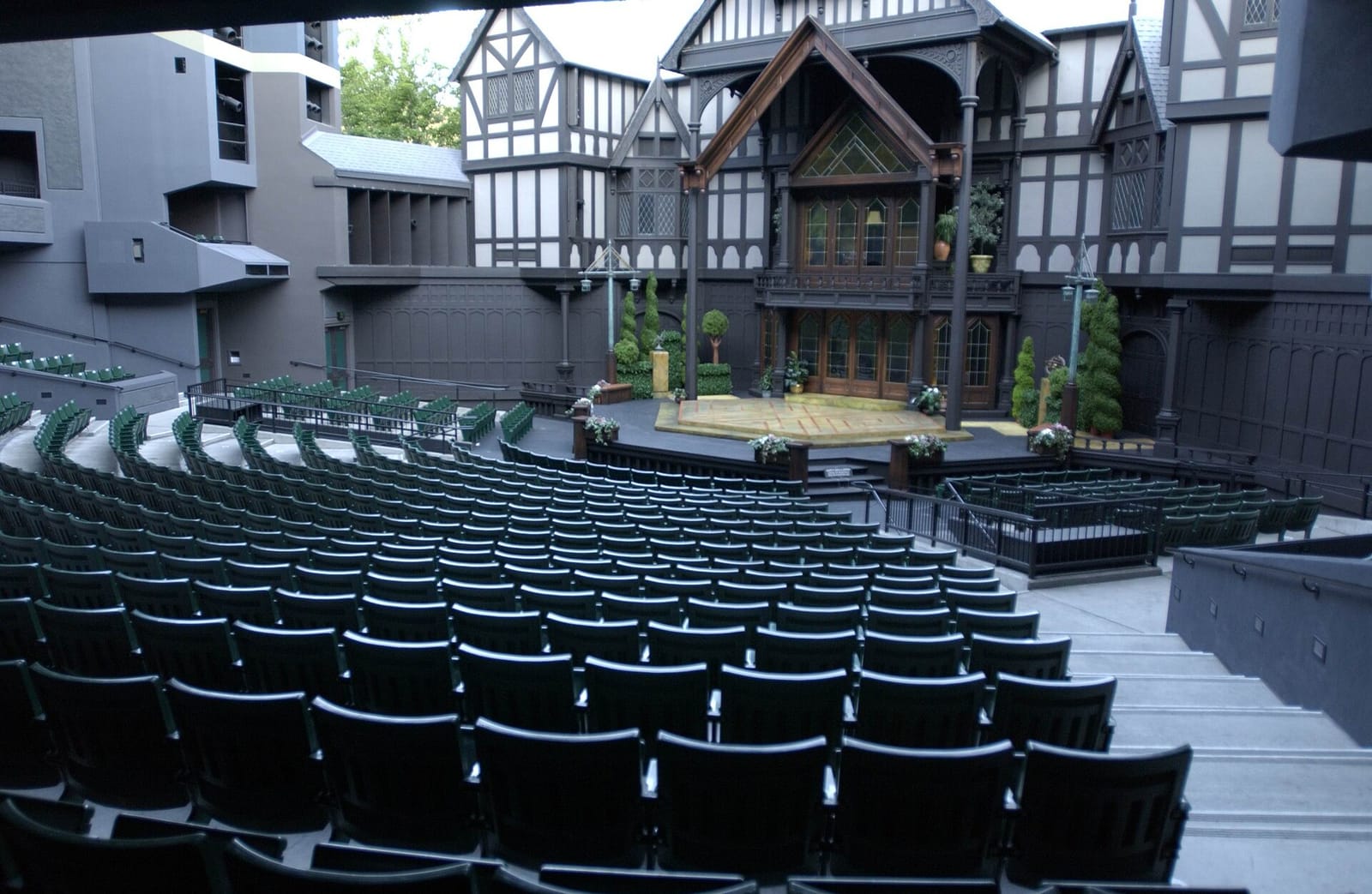
The tips of my fingers are numb around my pen. It’s cold and wet and the wind is whipping through the near-empty aisles of the Elizabethan theatre. The dress rehearsal for “Henry IV Part 2” has started with stylized swordplay set to martial music that makes my heart pound. I’m here to watch T. Charles Erickson shoot pictures. The music is also a good soundtrack for Charlie, Charlie who doesn’t feel the cold.
“As soon as a show starts, my body temperature goes up two degrees,” he says. It’s because his adrenaline is pumping. For Charlie, this is Showtime. He’s on. And he says he’s “in the zone.”
He’s a dancer, I scribble on my pad; he’s always on the toes of his New Balance sneakers; then I write how he reminds me of a football running back chased by giants, or, even better, a warrior well-armed, the way he stops and swings one of the two Canon cameras around his neck up to his eyeball in a single swift fluid motion, and shoots in measured bursts.
“I roam, I run,” Charlie says. Charlie roams and runs around the theatre in search of new angles and more compelling perspectives. Running, says Charlie, is his “signature.”
A dream job
Charlie, 57, who’s one of only a handful of full-time theatre photographers in the country, has been hired for his sixteenth season by the Oregon Shakespeare Festival to record still images of the shows at the Elizabethan stage, augmenting the work of staff shooter Jenny Graham. (David Cooper, another theatre specialist, travels here from Vancouver to shoot the shows on the indoor stages.)
I caught up with Charlie a day before his annual 10-day “exhaustathon”—he shoots two rehearsals each of the three outdoor season’s shows; when he’s not shooting, he’s chained to his computer, editing and culling the thousands of images.
After downing his usual tofu burger at Greenleaf downtown, he joins me for a walk through Lithia Park, a go-cup of Nobel’s coffee in his fist, and tells me how he’s lived in Ashland for a total of six months…spread over the decade and a half, and how he first fell in love with the town in 1995 when he flew here from his home base in New Haven, Conn. to shoot his first OSF play, “Blood Wedding.” I tell him he can keep the East Coast, but that, as a photographer myself, I’m envious of his gig. He smiles and says I have good reason.
“I have a dream job,” he says, before ticking off the names of some of the most prestigious shrines to professional non-profit theatre in the country. OSF is in good company; the others include the Long Wharf Theatre in his home town, New York’s Lincoln Center Theatre and the Guthrie Theatre in Minneapolis and the Alley Theatre in Houston.
Why Charlie runs
Shooting performances of dance, theatre, music and opera professionally since the late 1970s, he says he can take “some credit” for way theatre photography has evolved. When he started in the business, photographers relied almost entirely on post-rehearsal “set-ups.”
“It was usually late at night. They’d call the actors back, put them in costumes that they’d drenched with sweat an hour before, then ask them to dredge up an emotional moment they’d found before in real time.
“Usually, when actors are performing, there’s a light bulb switched on behind their eyes; when they’re not, when they’re just posing, the bulb’s turned off. In the very best circumstances, we’d get pictures that were useable, but not very convincing as actual dramatic moments.
“The pictures I wanted to make were of the real, honest-to-God moments of emotional truth that can only be arrived at during a production, through a build-up of dialog and interaction.”
That’s why Charlie roams; that’s why he runs. And it’s why he watches entire shows through the viewfinder. “What I’m going for is that look of peak involvement between the actors at the first instant, say, when a tragedy registers on their faces.
“If you’re seeing that scene with your naked eye, you’ve missed the picture,” he says. “My task is to find a two-dimensional visual equivalent of a three-dimensional emotional experience that involves sound,” says Charlie. “What’s helpful is my ability to lock onto the core emotional content of a presentation.”
Even if he comes into a theatre cold, without having read the play, Charlie says he’s good at anticipating. “I can feel the emotional temperature rising and sense how that might translate into a visual moment. If everyone on stage is doing their work right, there’s not a whole lot of guessing about what meaning it is that they’re intending to impart.”
In the way landscape or nature photographers are sensitive to the “natural geometry of the world,” Charlie and other theatre shooters are sensitized to the “natural geometry” and architecture of a play. Those decisions about when and what to shoot, however, are not necessarily conscious.
“I’m not really deciding or thinking so much as I’m flowing through the experience,” he says. “I am totally in the moment, completely and utterly involved with what’s in front of me. God knows I’m not thinking about my car payments.”
“If you’re seeing that scene with your naked eye, you’ve missed the picture,” he says.
The rain shot
Charlie isn’t always running to get the perfect shot. And sometimes, it happens when he least expects it. A year ago, set up on a high perch with a tripod to shoot an “audience shot” of the theatre during a performance of “Merchant of Venice,” Charlie thought he was wasting his time.
“It’s raining hard and I’m looking down and everyone in the audience is covered in plastic and ponchos. I said to myself, ‘No one’s going to want to use that photo.’ But I’m supposed to be here until intermission and I’ve got to try to make a picture.
“That’s when I noticed that the rain, caught in the spotlights, was making these criss-crossing beams, the way that smoke would. So I thought, ‘that’s not bad, that’s a design element.’”
The picture Charlie made that night, used frequently to promote the Festival, has become in iconic image and an instant classic. The only surprise is that he didn’t take it when he was on the run.
Questions people ask
- Who is T. Charles Erickson?
- A New Haven, Connecticut based theatre photographer, one of only a handful working full time in the United States, who in 2011 was in his sixteenth season shooting Oregon Shakespeare Festival's outdoor Elizabethan stage.
- Which other theatres does he shoot?
- Long Wharf Theatre in New Haven, Lincoln Center Theatre in New York, the Guthrie Theatre in Minneapolis and the Alley Theatre in Houston, among others.
- What is the famous rain photograph?
- An audience shot of the Elizabethan theatre during a rainy performance of The Merchant of Venice, where rain caught in the spotlights formed criss-crossing beams; the Festival has used it widely in promotion.
Sources
This page was rebuilt from the Commission’s archived website. It is kept for reference; see the home page for what the Commission was.