Training at the sports bar
A few days before I saw “Medea, Macbeth and Cinderella,” I took my lunch at a sports bar. On one screen, I watched the Yankees; at the same time, on another, I tracked the Celtics; on a third I followed a soccer match, teams unknown.
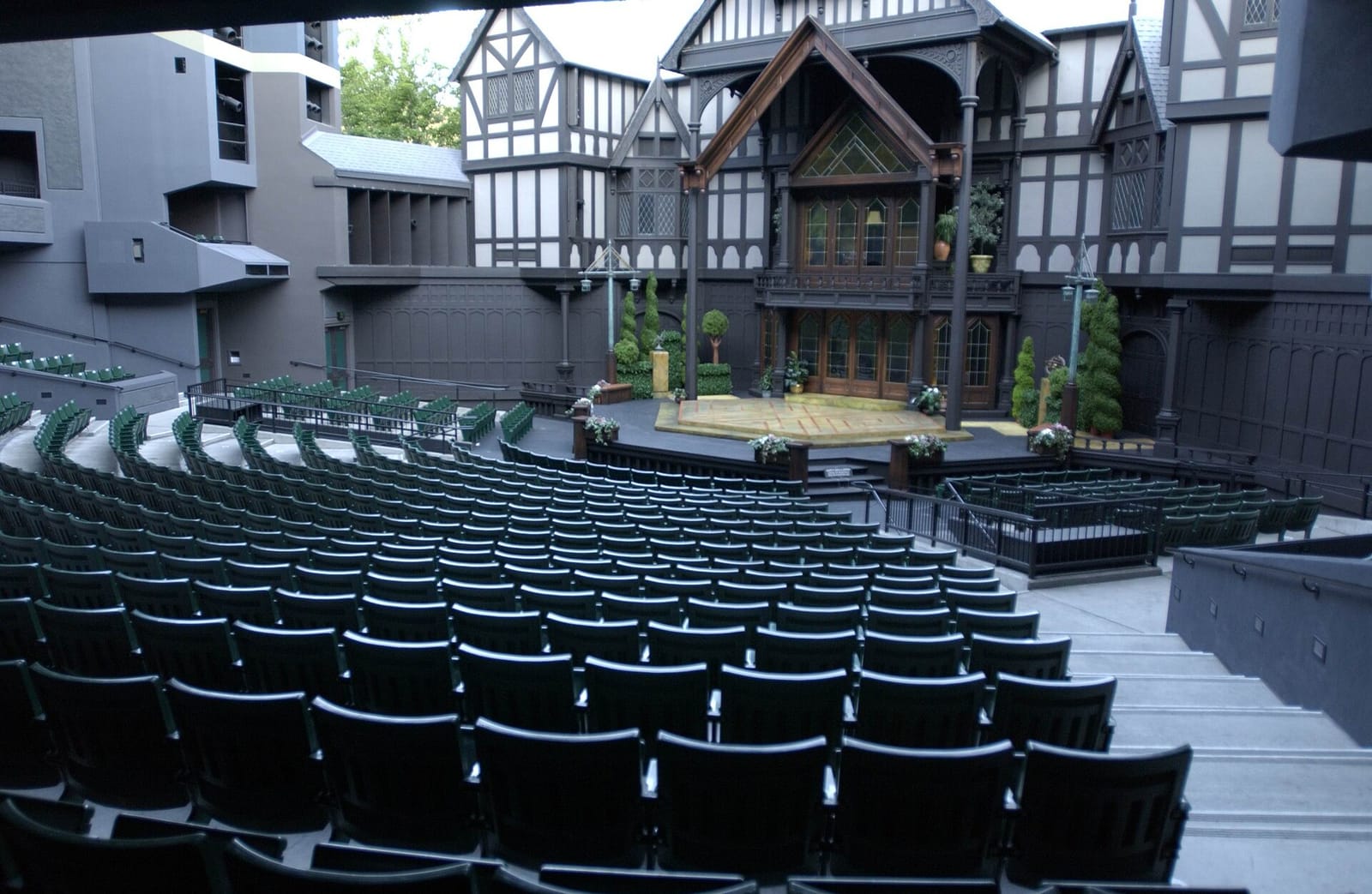
It wasn’t until I settled into my seat at the Angus Bowmer Theatre and the play began, that I realized I hadn’t just been having lunch that day; I’d been in training to take in this extraordinary theatrical experience.
Kidding aside, while a mastery of multi-tasking may enhance the appreciation of this simultaneous showing of the three plays on a single stage, it really isn’t necessary.
That is because the creators of this multi-layered masterpiece, Bill Rauch and Tracy Young, have managed to pull off a miracle. While a description of the concept might suggest a chaotic cacophony, there is nothing to the ear or to the eye that could be considered harsh or dissonant. In fact, the harmonious chords extruded from the scripts of these classics are mindbendingly magnificent.
Most surprising is that each of these tales, in its own way, is related with coherence and with a bell-ringing clarity. I left the theatre certain that I had, in fact, seen—really seen—three complete plays. (Check that. I suppose I’d really seen four plays, including MMC itself, an entirely new creature with its own dramatic DNA.)
Three plays, one stage
Here’s the idea: Euripedes’ “Medea,” the story of a vengeful wife of heroic proportions; Shakespeare’s “Macbeth,” a tale tracing the tragic end to relentless ambition; and Rogers and Hammerstein’s musical “Cinderella, a celebration of romantic love, share a single, multi-level, neutral-black stage.
Three complete and discrete casts, costumed expertly by Deb Dryden to maintain the distinctions and avoid confusion, play out their respective parts as though in three overlapping dimensions. But only most of the time.
Just often enough, characters—along with a few very special props, like a royal crown—cross through a semi-permeable membrane of imagination from their dimension to the other, coming together occasionally for the musical production numbers from “Cinderella.” And that is what makes this magical mélange as deliriously delicious, delightful and, on occasion, as outrageously funny as it is.
The cottony candy fluff of those numbers, while providing a comic counterpoint, also serves to enhance and intensify the import of the enfolding tragedies. And make no mistake: these are horrible, graphic, blood-curdling, heart-wrenching tragedies we are made to witness. When Medea kills her children with her bare hands, I had to avert my eyes.
Clearly, with a holy theatrical chutzpah, Rauch and Young have meticulously crafted—and solved—a theatrical puzzle in four dimensions, the fourth being time. In fact, it’s the spot-on timing of the seemingly accidental juxtapositions of dialog that makes this production as juicy as it is. As when Medea says, “We are on the road to vengeance,” and Cinderella, in her own bubble, seems to reply, “Wonderful!”
When Medea kills her children with her bare hands, I had to avert my eyes.
World class performances
There is so much good, and even grand, about the scope of this production, that it might be easy to be distracted from such world class performances as Miriam Laube’s as the gorgeous and murderess Medea. No matter how much is happening on stage, she compels attention. With his commitment and emotional intensity, Christopher Liam Moore gives us a Lady MacBeth who commands our sympathies. Bravo too to K.T. Vogt whose broadly-played Cinderella’s Godmother was most hysterical when she played off cast members in the other dimensions. In fact, credit is due to the entire ensemble for maintaining concentration through what must surely be challenging circumstances.
To smooth over any roughly cut seams between the stories, Rauch and Young added the character of “the usher,” casting the comic role with the brilliant Mark Bedard who appears to be everything and everywhere as the thread that binds the pieces of the tapestry.
The fresh and lively choreography by Sabrina Peck not only injects a playful exuberance throughout, but she misses no opportunity to create moments of hilarity. With all three casts comingling as guests at the Cinderella ball, the prince finds himself dancing not only with wannabe royalty but with the hideous witches from “Macbeth,” played by big hairy men.
Though it evolved from Rauch’s experimentation as a college student, “MMC” should not at all be considered a novelty; having been remounted a number of times in the past few decades, it ought by now to be considered a classic in its own right. See it more than once, if you can, through Nov. 3 at the Angus Bowmer Theatre.
Questions people ask
- What is Medea/Macbeth/Cinderella?
- A simultaneous staging of Euripides' Medea, Shakespeare's Macbeth and Rodgers and Hammerstein's Cinderella on a single stage, created by Bill Rauch and Tracy Young and first developed when Rauch was a college student.
- Where and when did it play?
- At Oregon Shakespeare Festival's Angus Bowmer Theatre in Ashland, Oregon, through November 3, 2012.
- Who was in the cast?
- Miriam Laube as Medea, Christopher Liam Moore as Lady Macbeth, K.T. Vogt as Cinderella's Godmother and Mark Bedard as the usher, with costumes by Deb Dryden and choreography by Sabrina Peck.
Sources
This page was rebuilt from the Commission’s archived website. It is kept for reference; see the home page for what the Commission was.